
MIDA investment incentives are tax and duty relief programs administered by the Malaysian Investment Development Authority for companies undertaking qualifying manufacturing or services projects in Malaysia. As of 2026, the system foreign companies actually apply through is not the Pioneer Status and Investment Tax Allowance regime most guides still describe. It is the New Incentive Framework (NIF), which took over new manufacturing applications on 1 March 2026 and extends to services in the second quarter of 2026.
That timing matters if you are budgeting a Malaysia entry around a specific incentive figure you read somewhere. A number that was accurate in 2025 may no longer be the number MIDA actually applies to your application today.
Key Takeaways
- New manufacturing incentive applications under the old Promotion of Investments Act 1986 stopped being accepted on 28 February 2026. Every new manufacturing application since 1 March 2026 goes through the New Incentive Framework (NIF) instead.
- Under the NIF, companies apply for one of two mutually exclusive incentives: a Special Tax Rate (STR) of 0 to 15 percent for up to 15 years, or an Investment Tax Allowance (ITA) of up to 100 percent of qualifying capital expenditure, also for up to 15 years.
- Malaysia recorded RM426.7 billion in approved investments in 2025, up 11 percent year on year, with foreign investment rising 20.9 percent to RM207.1 billion.
- Applying for any MIDA incentive requires an already-incorporated Malaysian company. A full first-year setup package for a foreign-owned entity typically runs USD 2,794 to USD 5,331 before the incentive application even begins.
What Investment Incentives Does MIDA Offer to Foreign Companies?
MIDA is Malaysia’s principal government agency for investment promotion, operating under the Ministry of Investment, Trade and Industry (MITI). Its incentive powers come from a stack of legislation, including the Promotion of Investments Act 1986, the Income Tax Act 1967, the Customs Act 1967, the Excise Act 1976, and the Free Zones Act 1990, which together cover manufacturing, agriculture, tourism, approved services, R&D, training, and environmental protection activities.
Direct tax incentives reduce or exempt income tax for a set period. Indirect incentives exempt import duty and excise duty on qualifying goods. Historically, MIDA channeled most manufacturing applicants into two products: Pioneer Status and the Investment Tax Allowance. Both still exist for companies that were already approved before the 2026 cutover, but they are no longer what a new applicant files under.
How the New Incentive Framework Replaced Pioneer Status in 2026
The New Incentive Framework, or NIF, is the Malaysian government’s outcome-based replacement for the old activity-list system. Instead of qualifying because your product sits on a promoted list, your project is scored against Malaysia’s National Investment Aspirations (NIA) and the New Industrial Master Plan 2030 (NIMP 2030) using what MIDA calls the NIA Scorecard.
The rollout is staged. Manufacturing moved over on 1 March 2026, and MIDA stopped taking new manufacturing applications under the Promotion of Investments Act 1986 at 3pm on 28 February 2026. Services follow in the second quarter of 2026, with the exact date to be confirmed by MIDA. Companies with incentive approvals granted before the cutover keep operating under their original terms, so an existing Pioneer Status certificate is not affected.
The reform was driven partly by the OECD’s Global Minimum Tax, which sets a 15 percent effective tax floor for large multinational groups. A blanket tax holiday loses much of its value once a top-up tax can claw the rate back to 15 percent anyway, so Malaysia rebuilt its incentive system around measurable contribution instead of headline tax breaks. The Ministry of Finance’s Taskforce on Incentive Review, which includes MITI, MIDA, the Inland Revenue Board, Bank Negara Malaysia, and the Malaysia Digital Economy Corporation, led the redesign.
Notes from InvestinAsia Consultants
We’re already fielding questions from clients who read a Pioneer Status write-up from 2024 or 2025 and built a financial model around it. That model needs revisiting. The NIA Scorecard evaluates things a flat five-year tax holiday never asked about, including workforce skill mix and supply chain linkages, so a project that looked strong under the old promoted-list system does not automatically score well under the new one. Get your project mapped against the scorecard pillars before you finalise a capex plan, not after.
What Is the Difference Between the Special Tax Rate and Investment Tax Allowance?
Under the NIF, eligible companies choose one of two mutually exclusive incentives for a given project.
| Feature | Special Tax Rate (STR) | Investment Tax Allowance (ITA) |
|---|---|---|
| What it does | Reduces the corporate tax rate to between 0 and 15 percent | Grants an allowance of up to 100 percent on qualifying capital expenditure |
| Maximum duration | Up to 15 years | Up to 15 years |
| Offset against statutory income | Applies to the reduced rate directly | 60 to 100 percent, depending on tier |
| Losses carried forward | Up to 7 consecutive years | Unutilised allowance carried forward until fully used |
| Best suited to | Projects expecting profitability relatively early | Capital-intensive projects with a longer payback period |
Which one a company gets, and at what tier, depends on its score against the NIA Scorecard rather than a fixed rule. Two Tier levels apply: meeting the minimum commitments generally lands a project in Tier 2, while exceeding them can move a company into the more favourable Tier 1.
Which Sectors and Activities Qualify for MIDA Incentives?
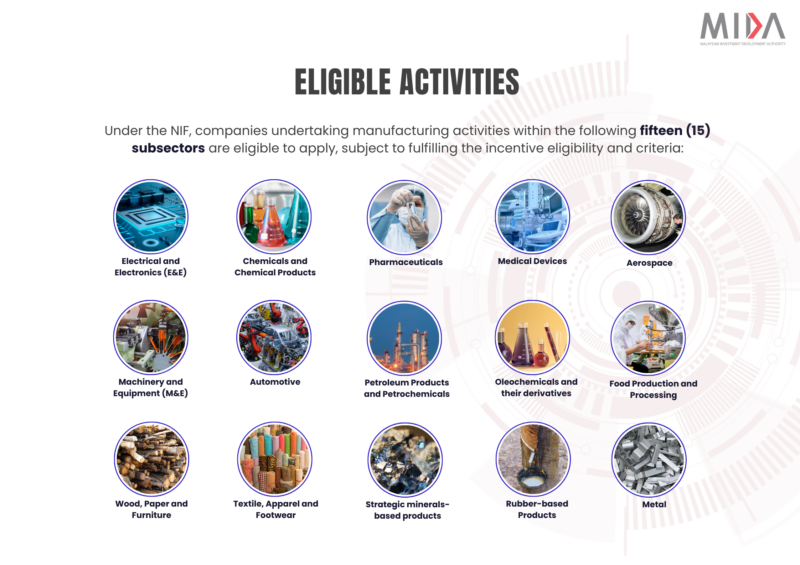
The manufacturing side of the NIF applies to 15 priority subsectors, including electrical and electronics, chemicals and chemical products, pharmaceuticals, medical devices, aerospace, machinery and equipment, automotive, petrochemicals, food production, textiles, apparel, and metal products. A general list of excluded activities also exists within each subsector, so sitting inside a priority category does not automatically mean every activity within it qualifies.
To even reach scoring, a manufacturing project generally needs to hold a valid manufacturing licence under the Industrial Coordination Act 1975 before applying, and that licence has to stay valid for the entire incentive period. Once past that gate, projects are pre-qualified and then scored on measurable contributions such as technology adoption, high-skilled job creation, domestic supply chain linkages, and sustainability practices.
Beyond manufacturing, MIDA also promotes agriculture, tourism and hotel projects, approved services, R&D, training, and environmental protection activities. These fall under the same underlying legislation, though services-sector applications remain under the pre-NIF rules until MIDA confirms the Q2 2026 cutover date.
How Do You Apply for MIDA Investment Incentives?
The application has to happen before you start operations or production, not after. In practice, it runs through a defined sequence.
Pre-application consultation
Engaging MIDA early to confirm your activity sits inside an eligible subsector avoids the common mistake of assuming eligibility from a sector label alone.
Digital submission
Applications go through the InvestMalaysia portal, along with a business plan, machinery and process details, and workforce composition data.
NIA Scorecard evaluation
MIDA assesses the project against the scorecard’s pillars, covering technology transfer, job quality, industry linkages, and sustainability contribution.
Approval by the National Committee of Investment
If the NCI approves the application, MIDA issues a Principle Approval Letter setting out the incentive type, tier, incentive period, and the performance conditions attached to it.
Determination of commencement year
The company must then apply for determination of the commencement year of assessment within the timeframe MIDA specifies in the approval letter. Missing that window can result in the principle approval being automatically cancelled, so this step is not optional paperwork.
Not sure which incentive fits your project’s profile?
InvestinAsia’s Malaysia team maps your project against current eligibility rules before you approach MIDA, not after.
What Does It Cost to Set Up the Company That Applies?
A MIDA incentive application is not something a founder files as an individual. It has to come from an incorporated Malaysian company, which means company registration is the step before the incentive step, not an afterthought.
Registering a Sdn Bhd carries a government fee, but the real first-year cost includes a corporate secretary, a registered address, and banking support. A standard first-year setup package for a foreign-owned Malaysia company, bundling incorporation, corporate secretary and statutory registration for one year, a virtual office, and banking introductions, runs around USD 2,794. A more complete package that adds a year of accounting and tax filing for up to 300 transactions runs around USD 5,331. Companies needing a Wholesale, Retail and Trade licence pay an additional USD 269, and a certified Malaysian residential address for a bank signatory runs USD 609 per year. Typical registration takes 5 to 7 business days once documents and payment are in.
Also read: What Is a Sdn Bhd in Malaysia? The Complete Guide to Registration, Costs, and Requirements
Founders sequencing a Malaysia entry sometimes register the company first and treat the MIDA incentive as a separate project to sort out later. That works, but it wastes time. Since the incentive application has to happen before operations start, and the company needs to already exist to file it, lining up incorporation and the incentive application in parallel is faster than treating them as two sequential projects. A closer look at the registration process for foreign investors in Malaysia covers the entity and licensing side in more depth.
What Other Incentives Can Run Alongside STR or ITA?
The NIF is not the only incentive path available, and several of the following can stack with it or run for companies outside the manufacturing scope entirely.
Principal Hub Incentive
A company using Malaysia as its base for regional management, finance, and risk control functions can apply for Principal Hub status, which can bring the effective rate down to as low as 0 to 10 percent for a defined period, without a minimum local ownership requirement attached.
Free Industrial Zone and Free Commercial Zone Benefits
Companies operating inside one of Malaysia’s Free Industrial Zones or Free Commercial Zones get customs duty, excise duty, and sales tax exemptions on approved activities under the Free Zones Act 1990, independent of whether they also hold an STR or ITA. The two sets of benefits are designed to stack.
Also read: Malaysia Free Trade Zones: FIZ vs FCZ, Benefits, and How to Set Up
Green Technology and Digital Economy Incentives
Separate programs exist for green hydrogen, solar, and waste management projects through the Green Investment Tax Allowance, and for technology companies through Malaysia Digital (MD) Status, which offers a 0 percent rate on qualifying intellectual property income.
What Happens If a Company Doesn’t Meet Its Incentive Commitments?
The NIF’s outcome-based design cuts both ways. Because tiering is tied to performance against the NIA Scorecard, MIDA monitors post-approval commitments rather than treating the Principle Approval Letter as the end of the process. A company that meets only its minimum conditions can expect Tier 2 treatment, while under-delivery against approved commitments puts continued eligibility at risk.
There is also a tax layer to watch regardless of tier. If a company’s parent group falls under the OECD’s Pillar Two rules, with global revenue of at least EUR 750 million, Malaysia’s Domestic Top-up Tax can apply if the group’s effective tax rate drops below 15 percent, even where an STR or ITA would otherwise bring it lower. A closer look at how this interacts with Malaysia’s standard 24 percent corporate rate for foreign-owned companies is covered in InvestinAsia’s guide to corporate tax for foreign-owned companies in Malaysia.
Notes from InvestinAsia Consultants
Clients occasionally assume that once MIDA issues the Principle Approval Letter, the work is done. It isn’t. The letter comes with conditions attached to the tier you were scored into, and MIDA’s monitoring is ongoing rather than a one-time check. Build the reporting obligations into your compliance calendar from day one instead of treating them as a renewal-year surprise.
Is Malaysia Still Attracting Strong Foreign Investment Under the New System?
The headline numbers so far say yes. Malaysia recorded RM426.7 billion in approved investments across 8,390 projects in 2025, an 11 percent increase from RM384.4 billion in 2024. Foreign investment grew faster than the total, rising 20.9 percent to RM207.1 billion, with Singapore and China as the two largest sources. Manufacturing alone attracted RM131.3 billion, with foreign investors contributing 76.6 percent of that figure.
Those numbers reflect activity mostly approved before the NIF cutover, so they are not yet a verdict on the new framework specifically. MIDA’s own messaging around the transition has been that the shift trades a simpler qualification test for a more selective one, aiming for fewer but higher-value approvals rather than a drop in investment volume. Whether that holds will show up in the 2026 figures MIDA publishes in early 2027.
Ready to set up the entity your MIDA application will need?
InvestinAsia handles Malaysia company registration end to end, with a money-back guarantee.
References
1. Malaysian Investment Development Authority (MIDA). New Incentive Framework (NIF). Retrieved from
2. Malaysian Investment Development Authority (MIDA). Incentives for New Investments. Retrieved from
3. Ministry of Investment, Trade and Industry (MITI). New Incentive Framework (NIF). Retrieved from
https://www.miti.gov.my/NIF
4. Malaysian Investment Development Authority (MIDA). Malaysia Records Historic RM426.7 Billion in Approved Investments for 2025, Up 11% Year-on-Year. Retrieved from
Malaysia Records Historic RM426.7 Billion in Approved Investments for 2025, Up 11% Year-on-Year
5. KPMG Malaysia. New Incentive Framework. Retrieved from
https://kpmg.com/my/en/insights/2026/01/new-incentive-framework.html
6. vOffice. Malaysia Company Registration Service (Sdn. Bhd.), Pricing and Packages. Retrieved from
https://voffice.co.id/en/services/company-registration-malaysia