The Greater Bay Area is the Guangdong-Hong Kong-Macao economic cluster linking Hong Kong and Macao with nine mainland cities in Guangdong province, coordinated under a national development plan that treats the 11 cities as one integrated market for talent, capital, and goods. For a business already based in Hong Kong, the phrase shows up constantly in government speeches and pitch decks, but it rarely comes with a straight answer to the question that actually matters: what does it let your company do that it could not do before.
Key Takeaways
- The GBA’s 11 cities generated GDP of roughly RMB 15 trillion (about US$2.1 trillion) in 2024, according to the HKSAR government’s Bay Area Development Office, with Hong Kong, Shenzhen, and Guangzhou as the three largest economies.
- Cross-boundary Wealth Management Connect lets eligible Hong Kong and mainland GBA residents invest across the border with an individual quota of RMB 3 million, on top of Hong Kong’s existing access to mainland equities through Stock Connect.
- Qianhai, Nansha, and Hengqin, three special cooperation zones inside the GBA, offer qualifying enterprises a 15% corporate income tax rate against the mainland’s standard 25%, a incentive most GBA overviews never actually name.
What Is the Greater Bay Area, and Which 11 Cities Does It Include?
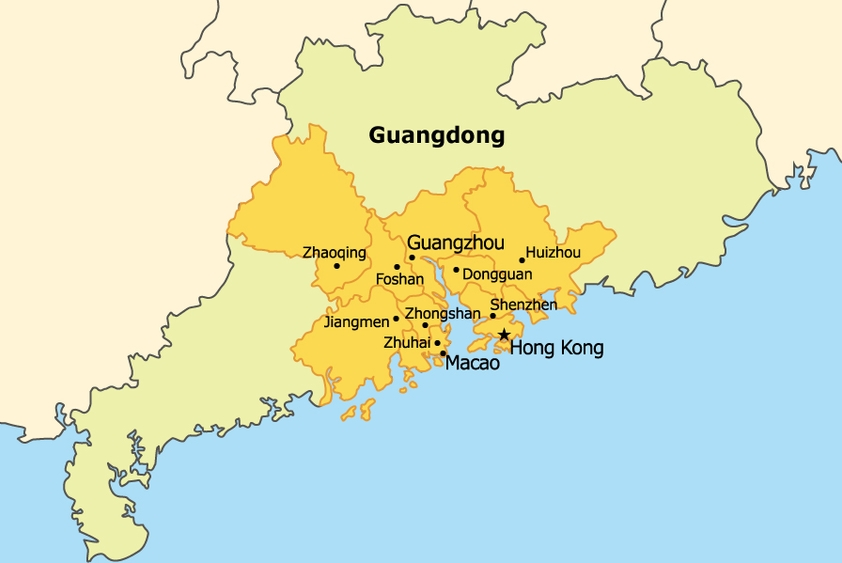
The Guangdong-Hong Kong-Macao Greater Bay Area groups Hong Kong and Macao with nine Guangdong cities: Guangzhou, Shenzhen, Zhuhai, Foshan, Huizhou, Dongguan, Zhongshan, Jiangmen, and Zhaoqing. The framework was formalized in 2017 through the Framework Agreement on Deepening Guangdong-Hong Kong-Macao Cooperation, and the region spans about 56,000 square kilometers with a combined population above 86 million.
Two cities carry most of the weight. Shenzhen is the technology and manufacturing engine, with civilian drone, industrial robot, and 3D printing output all growing sharply through 2025. Guangzhou anchors trade and logistics. Hong Kong’s role sits apart from both: financial services make up roughly 90% of Hong Kong’s own GDP, and the city functions as the GBA’s international-facing capital markets and legal hub rather than a manufacturing node.
How Big Is the Greater Bay Area Economy Right Now?
Combined GDP across the 11 GBA cities reached approximately RMB 15 trillion, or about US$2.1 trillion, in 2024, according to figures compiled by Hong Kong’s Bay Area Development Office. Guangdong’s provincial session projected the 2025 total would surpass RMB 15 trillion again, putting the region’s output ahead of Australia’s and close to South Korea’s on a national-economy comparison.
Hong Kong itself reported GDP of roughly HK$2,839 billion, with Shenzhen at RMB 2,422 billion and Guangzhou at RMB 2,286 billion, the three largest of the 11 economies. Zhaoqing sits at the other end, at RMB 220 billion, a reminder that “the GBA” is not one uniform market but a cluster of cities at very different stages of development, each suited to a different function in a company’s structure.
How Does a Hong Kong Company Actually Get Operational Access Into the GBA?
A Hong Kong company does not get automatic mainland market access simply by existing. The legal pathway runs through the Mainland and Hong Kong Closer Economic Partnership Arrangement, commonly known as CEPA, which grants qualifying Hong Kong Service Suppliers preferential access to sell services on the mainland across roughly 96% of WTO-classified service sectors. InvestinAsia’s guide to CEPA covers the certification process in detail, since incorporating in Hong Kong alone does not automatically grant CEPA treatment; a separate certificate has to be applied for.
Inside the GBA specifically, three special cooperation zones function as accelerated entry points: Qianhai in Shenzhen, Nansha in Guangzhou, and Hengqin in Zhuhai. Officials at Qianhai’s Financial Regulatory Bureau have described a “green channel” for Hong Kong and Macao enterprises, aiming to process applications within a month, faster than the standard mainland registration timeline. For businesses weighing whether to route operations through one of these zones or set up a straightforward mainland entity instead, the choice usually comes down to the same holding-versus-operating question covered in InvestinAsia’s guide to onshore versus offshore structures.
Not sure if your Hong Kong company already qualifies for CEPA or zone access?
We check your sector against the current framework before you build a GBA strategy around assumptions.
What Do Wealth Management Connect and Stock Connect Actually Offer Hong Kong-Based Investors?
Cross-boundary Wealth Management Connect, launched in September 2021 and enhanced as “WMC 2.0” in February 2024, lets eligible residents in the GBA invest in wealth products distributed on the other side of the border through a closed-loop banking channel. The 2024 enhancement raised the individual investor quota from RMB 1 million to RMB 3 million and expanded the range of eligible products and participating institutions, according to the Hong Kong Monetary Authority. The scheme runs on an aggregate quota of RMB 150 billion in each direction, Northbound and Southbound, shared across Hong Kong and Macao.
Stock Connect is a separate, older mechanism, first launched between the Shanghai and Hong Kong exchanges in 2014 and extended to Shenzhen in 2016, that lets international investors trade eligible mainland-listed shares through Hong Kong brokers without needing a separate mainland trading license. It is not GBA-specific in the way WMC is, but for a Hong Kong-based investor or corporate treasury looking at the region’s capital markets, the two schemes together form the practical on-ramp: WMC for retail-style wealth products, Stock Connect for direct equity exposure.
Notes from InvestinAsia Consultants
Clients often ask about WMC assuming it applies to any company they own. It does not. WMC is built around individual investor accounts and specific residency and asset thresholds, not corporate treasury accounts, so a business looking to move company funds across the border needs a different structure entirely, usually built around the Hong Kong holding layer rather than the WMC channel itself.
What Tax Incentives Do Qianhai, Nansha, and Hengqin Offer Hong Kong Companies?
Qianhai, Nansha, and Hengqin each offer qualifying enterprises a reduced corporate income tax rate of 15%, against the mainland’s standard 25% rate, under notices most recently extended by China’s Ministry of Finance and State Taxation Administration through 2025. The 15% rate is not automatic. It applies only to enterprises whose main business falls within a published catalogue of encouraged industries for that specific zone, generally financial, professional, and modern service sectors rather than general trading or manufacturing.
The comparison against Hong Kong’s own rate is worth being precise about. Hong Kong’s two-tier profits tax runs at 16.5%, or 8.25% on the first HKD 2 million, but only on Hong Kong-sourced profits, a distinction InvestinAsia’s guide to Hong Kong’s territorial tax system covers in more depth. A 15% GBA zone rate on mainland-sourced income and Hong Kong’s territorial exemption on genuinely offshore income are two separate tools, and structuring both correctly usually means the difference between paying tax twice on the same income and paying it once, at the lower of the two applicable rates.
Can Hong Kong Professionals and Firms Operate Directly in Mainland GBA Cities?
Mutual recognition of professional qualifications is one of the more overlooked pieces of GBA integration. Eligible Hong Kong solicitors and barristers who pass the GBA Legal Professional Examination can obtain a Lawyer’s License (GBA), allowing them to handle certain civil and commercial matters across the nine mainland GBA cities under mainland law. Hong Kong accountants who complete the Hong Kong Institute of Certified Public Accountants’ Qualification Programme are exempt from four papers of the mainland’s Uniform Certified Public Accountant Examination, and engineers in five pilot disciplines, including civil and geotechnical engineering, can now obtain mainland “Professional Title” qualifications through an evaluation mechanism the Development Bureau moved to regularize in 2025.
Notes from InvestinAsia Consultants
We see the same assumption trip up more than one client a quarter: that a Hong Kong professional license is automatically valid across the border because both jurisdictions are part of “one country.” It is not. Each profession has its own separate recognition agreement, its own exam or exemption pathway, and its own scope limits, so the right first step is checking whether your specific profession has a signed mutual recognition arrangement at all before assuming your team can practise or sign off on work in a mainland GBA city.
What Are the Risks and Limits of Using a Hong Kong Company to Operate in the GBA?
None of this removes the restrictions that still sit on the mainland side. China’s Foreign Investment Negative List still requires a Chinese joint-venture partner in sectors like civil aviation, value-added telecom, and select agriculture, and a Hong Kong company does not bypass that list on its own, a point covered in more detail in InvestinAsia’s guide to China’s negative list. If your business model requires invoicing mainland customers directly, hiring mainland staff, or issuing RMB tax invoices, a Hong Kong entity is a holding and gateway layer, not a substitute for a Wholly Foreign-Owned Enterprise registered on the mainland itself.
The financial connectivity schemes carry their own limits too. WMC’s aggregate and individual quotas can and do get tightened or expanded based on policy cycles, and both WMC and Stock Connect operate under closed-loop fund management, meaning money moved through these channels cannot be freely redirected outside the approved investment scope. Building a GBA strategy around a specific quota figure without a plan for policy adjustment is a common way that strategy runs into friction eighteen months in, not on day one.
How Much Does the Hong Kong Entity Behind a GBA Strategy Actually Cost?
Whatever the GBA strategy ends up looking like, it is anchored by the Hong Kong entity itself, and the underlying incorporation and compliance costs are worth stating plainly rather than leaving vague. A Hong Kong Limited Company needs a minimum of one shareholder and one director, a mandatory company secretary, and a Designated Representative for the Significant Controllers Register, distinct roles covered in InvestinAsia’s guide to company secretary requirements.
| Package | Total Fee | Covers |
|---|---|---|
| Essential | USD 2,644 | Incorporation, government fee, stamp duty, Articles of Association, 1 year corporate secretary, Business Registration Certificate (incl. HKD 2,200 government fee), neobank assistance |
| Complete | USD 5,109 | Everything in Essential, plus 1 year registered address/virtual office, neobank and traditional bank assistance, accounting and tax filing for up to 600 transactions a year |
Neither package includes what comes after incorporation. Every Hong Kong company, whether trading or dormant, files an annual CPA audit and annual return, running roughly USD 2,031 a year for a dormant holding company and closer to USD 3,406 once revenue is active but under HKD 5 million. Registration itself typically clears the Companies Registry within about three business days, with incorporation completed remotely in most cases, though opening a traditional bank account usually still requires a director’s physical presence in Hong Kong.
Ready to structure a Hong Kong entity built for GBA access, not just incorporation?
18+ years structuring foreign investment across Asia, including Hong Kong incorporation and China-facing structuring.
https://www.bayarea.gov.hk/en/about/the-cities.html
2. Financial Services and the Treasury Bureau / Shenzhen Municipal Government. Mainland Policies and Measures: Continuation of CIT Preferential Policy in Qianhai Shenzhen-Hong Kong Modern Service Industry Cooperation Zone (18 June 2025). Retrieved from
https://www.bayarea.gov.hk/en/resource/mainland-policies-measures-20250618.html
3. Hong Kong Monetary Authority. Cross-boundary Wealth Management Connect Scheme in the Guangdong-Hong Kong-Macao Greater Bay Area. Retrieved from
https://www.hkma.gov.hk/eng/key-functions/international-financial-centre/wealth-management-connect/
4. Government of the Hong Kong SAR. LCQ18: Cross-boundary Wealth Management Connect Scheme in the Guangdong-Hong Kong-Macao Greater Bay Area (12 June 2024). Retrieved from
https://www.info.gov.hk/gia/general/202406/12/P2024061200274.htm
5. Trade and Industry Department, HKSAR Government. Mainland and Hong Kong Closer Economic Partnership Arrangement (CEPA). Retrieved from
https://www.tid.gov.hk/en/our_work/cepa.html
6. Development Bureau, HKSAR Government. GBA Engineering “Professional Title” Evaluation. Retrieved from
https://www.devb.gov.hk/en/construction_sector_matters/service_promotion/GBA-Engineering-Professional-Title-Evaluation/index.html
7. vOffice. Hong Kong Company Registration Service (Limited Company): Plans & Inclusions. Retrieved from
https://voffice.co.id/en/services/company-registration-hongkong