The major industries in Indonesia are the 17 sectors BPS (Statistics Indonesia) uses to measure the country’s economic output, led by manufacturing, trade, agriculture, construction, and mining. As of the first quarter of 2026, those five sectors together account for roughly 63.5% of GDP. Indonesia’s economy grew 5.61% year on year in Q1 2026, the fastest pace in more than three years, after closing 2025 at IDR 23,821.1 trillion in GDP and 5.11% full-year growth.
If you’re sizing up Indonesia as a place to invest or trying to work out which sector actually has momentum right now, the short answer is that headline GDP share and real growth are telling two different stories in 2026. Manufacturing still leads by size, but its growth is cooling. Mining is still shrinking. And the fastest-growing sector in the country right now isn’t one most people would guess.
Key Takeaways
- Manufacturing remains Indonesia’s largest sector at 19.07% of GDP in Q1 2026, but its growth slowed to 5.04% year on year from 5.40% in Q4 2025, and the manufacturing PMI dipped into contraction territory (49.1) in April 2026.
- Indonesia’s economy grew 5.61% year on year in Q1 2026, its fastest quarterly pace since 2022, driven mainly by household consumption and a 21.81% surge in government spending tied to holiday bonuses and the free school meal program.
- Foreign direct investment reached IDR 900.9 trillion in 2025, 46.6% of Indonesia’s total realized investment of IDR 1,931.2 trillion, according to BKPM’s January 2026 report, and downstreaming investment jumped 43.3% year on year.
- Mining is the only sector still contracting, weighed down by soft nickel prices and reduced demand from China, Indonesia’s main buyer of processed nickel.
How Big Is Indonesia’s Economy in 2026?
Indonesia closed 2025 with GDP at current prices of IDR 23,821.1 trillion, roughly USD 1.4 trillion, and GDP per capita of USD 5,083. Full-year growth came in at 5.11%, just short of the government’s 5.2% target but still the strongest annual figure in three years.
Then Q1 2026 came in stronger than almost anyone expected. BPS reported 5.61% year-on-year growth, well above the 5.3% consensus from a Bloomberg survey of 32 economists, and the fastest quarterly pace since 2022, according to McKinsey’s Southeast Asia Quarterly Review. GDP at current prices reached IDR 6,187.2 trillion for the quarter. Household consumption did most of the work, contributing 2.94 percentage points to growth, helped along by Eid travel and spending. Government consumption jumped 21.81%, largely due to 14th-month salary payments to civil servants and continued rollout of the Free Nutritious Meals (MBG) program in schools.
There’s a catch worth flagging early. On a quarter-on-quarter basis, GDP actually contracted 0.77% in Q1 2026, a normal seasonal pullback after Q4’s year-end spending peak, not a sign of trouble. And manufacturing’s Purchasing Managers’ Index slipped to 49.1 in April 2026, down from 51.2 at the end of Q4 2025, which puts the sector just under the 50-point line that separates expansion from contraction. That’s a forward-looking signal worth watching heading into the rest of 2026, and it’s not something most sector overviews mention because they stop at the GDP numbers.
| Sector | GDP Share (FY 2025) | Full-Year Growth |
|---|---|---|
| Manufacturing | 19.07% | +5.30% |
| Wholesale and Retail Trade | 13.17% | +5.49% |
| Agriculture, Forestry and Fishing | 13.10% | Strong recovery |
| Construction | 9.83% | Positive |
| Mining and Quarrying | 8.75% | -0.66% |
| Transportation and Storage | ~6% | +8.87% |
| Information and Communication | ~4.5% | +7%+ |
| Financial and Insurance Activities | ~4.2% | +6%+ |
| Public Administration and Defense | ~2.9% | Stable |
| Education | ~2.8% | +10.59% (Q3) |
| Accommodation and Food Service | ~2.5% | +13.14% (Q1 2026) |
| Real Estate | ~2.4% | Stable |
| Other Service Activities | ~2% | +9.93% |
| Business Services | ~1.8% | +9.01% |
| Human Health and Social Work | ~1.2% | Stable |
| Electricity and Gas | ~1% | Positive |
| Water Supply and Waste Management | ~0.07% | Stable |
Source: BPS-Statistics Indonesia, Full-Year 2025 release (February 5, 2026) and Q1 2026 release (May 5, 2026). Top-5 shares updated where Q1 2026 figures are available in the sections below. Remaining sectors are full-year 2025 shares, since BPS has not yet broken out full sector detail for every category in Q1 2026.
What Changed in Q1 2026?
The ranking of Indonesia’s top five sectors held steady into 2026, but the gap between them moved. Manufacturing stayed at 19.07% of GDP. Trade actually grew its share to 13.28%, while agriculture slipped back to 12.67%, reversing the near-tie the two sectors had reached by the end of 2025. Construction held close to flat at 9.81%, and mining continued to lose ground at 8.69%, down from 8.75% for the full year.
Growth-wise, accommodation and food services was the standout at 13.14% year on year, the fastest of any sector, driven by holiday travel and continued expansion of the government’s free meal program. Other services grew 9.91%, and transportation and warehousing grew 8.04%. Manufacturing, trade, agriculture, and construction all posted positive growth, but two sectors, mining and electricity and gas, were the exceptions, both recording annual declines.
1. Manufacturing (19.07%)
Manufacturing is Indonesia’s largest sector and has held that position for years. Its full-year 2025 GDP share of 19.07% was the highest it has been in recent years, up from 18.98% in 2024. But the momentum is cooling. Growth eased to 5.04% year on year in Q1 2026, down from 5.40% in the previous quarter, and the sector’s PMI dropped into contraction territory in April 2026. That’s worth sitting with, because most articles on this topic still report manufacturing purely as a growth story.
Food and beverage production remains the anchor sub-sector, alongside metal goods, electronics, chemicals, and pharmaceuticals. BKPM’s January 2026 investment report shows the basic metals industry pulled in IDR 262.0 trillion in 2025, 13.6% of total national investment realization, making it the single largest recipient sector, a signal that foreign capital is still backing metals and downstream nickel processing even as headline manufacturing growth slows.
The nickel downstreaming story is central here. Indonesia accounts for around 58% of global nickel mine output, and the government’s downstreaming push has driven total downstream investment to IDR 584.1 trillion in 2025, up 43.3% year on year, according to BKPM. Foreign investors backed 73.5% of that figure. The Making Indonesia 4.0 roadmap remains the long-term policy backdrop pushing manufacturing toward higher-value production.
Foreign investors entering manufacturing typically register a PT PMA and, depending on the activity, may need a manufacturing-specific business license alongside the general NIB. InvestinAsia’s factory expansion services cover site selection, licensing, and setup for companies building production capacity in Indonesia.
Notes from InvestinAsia Consultants
A pattern we see often: foreign founders pick manufacturing because it tops the GDP table, then discover their specific product category actually falls under a different KBLI code with different foreign ownership limits. The GDP share tells you the sector is large. It does not tell you whether your exact activity is open to 100% foreign ownership. That’s a separate check against the Positive Investment List, and it’s worth doing before you commit to a location or a factory lease.
2. Wholesale and Retail Trade, Repair of Motor Vehicles and Motorcycles (13.28% in Q1 2026)
Trade is Indonesia’s second-largest sector and grew its GDP share to 13.28% in Q1 2026, up from 13.17% for full-year 2025. The sector grew 6.26% year on year in the first quarter, driven by higher domestic production and rising imports of consumer goods.
This category covers everything from large retail chains to neighborhood warungs, plus motor vehicle and motorcycle repair services. E-commerce continues to pull consumer spending online, and that shift has pushed foreign retail and logistics companies to enter through hybrid online-offline models, often structured through a PT PMA under the trade-related KBLI codes.
3. Agriculture, Forestry, and Fishing (12.67% in Q1 2026)
Agriculture’s trajectory is one of the more interesting reversals in the recent data. The sector surged in 2025, hitting 13.10% of GDP for the full year after a weak 2024, driven by a sharp rebound in rice and maize production. But its Q1 2026 share slipped back to 12.67%, as trade’s share pulled further ahead. Growth held steady at 4.97% year on year in Q1 2026, a more moderate pace than the double-digit spikes seen in early 2025.
Palm oil remains the sector’s main export earner. Indonesia produces roughly 60% of global supply and has been the world’s largest palm oil exporter for decades. Foreign agribusiness investment typically runs through PT PMA structures with sector-specific permits from the Ministry of Agriculture, and forestry activity separately falls under licensing from KLHK (the Ministry of Environment and Forestry).
4. Construction (9.81% in Q1 2026)
Construction held close to steady at 9.81% of GDP in Q1 2026, against 9.83% for full-year 2025. The sector grew 5.49% year on year in the first quarter, supported by both government and private construction activity. The Nusantara new capital city project in East Kalimantan remains the largest single ongoing construction commitment, with BPS reporting nearly 150,000 people now living there.
Foreign investors can participate in construction through PT PMA structures in specific sub-sectors: civil engineering, specialized construction, and integrated property development, each requiring the correct KBLI classification before applying for a business license.
5. Mining and Quarrying (8.69% in Q1 2026)
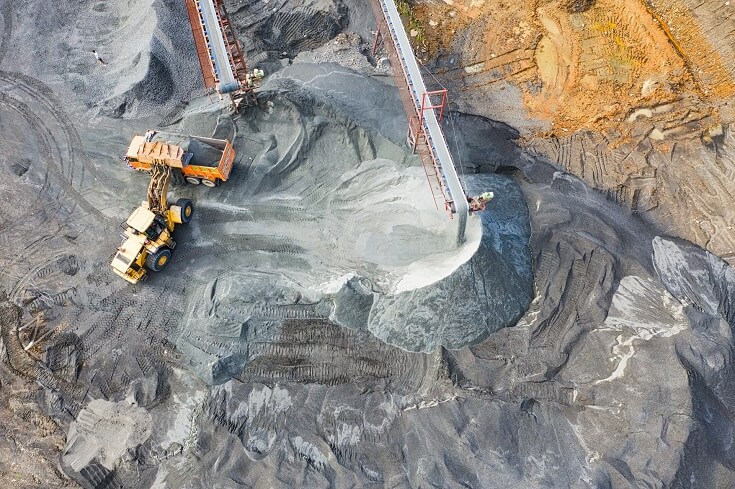
Mining is the only sector in BPS’s 17-sector classification to keep contracting into 2026. Its GDP share fell to 8.69% in Q1 2026, down from 8.75% for full-year 2025, when the sector shrank 0.66% for the year. On a quarter-on-quarter basis, the contraction was steep, output fell 8.20% compared to the previous quarter.
Nickel prices are the main driver. They collapsed from over USD 100,000 per tonne in March 2022 to roughly USD 16,000 to 18,000 by late 2024, and that repricing has continued working through the sector’s economics. Indonesia still holds around 58% of global nickel mine output and has built out ferronickel, nickel pig iron, and mixed hydroxide precipitate processing capacity in Sulawesi and Maluku. But the phase where building smelters alone generated easy value has passed. Coal remains Indonesia’s largest commodity export by volume, and continued demand from India and China has kept it economically relevant despite Western decarbonization pressure.
For investors, mining requires a longer time horizon than most GDP-share tables suggest, and a specific thesis beyond “Indonesia has nickel.”
Thinking About Entering One of These Sectors?
Our team of 380+ in-house professionals has helped foreign investors register companies across manufacturing, trade, agriculture, and more.
6. Transportation and Storage (~6%)
Transportation and storage grew 8.04% year on year in Q1 2026, after posting 8.87% for full-year 2025, one of the strongest full-year rates in the economy. Logistics demand from e-commerce, continued air travel recovery, and port infrastructure improvements are the main drivers. Indonesia’s archipelagic geography keeps logistics permanently in demand, and cold chain and last-mile delivery to secondary cities remain underserved. Foreign logistics companies typically enter through PT PMA structures in warehousing and freight forwarding.
7. Information and Communication (~4.5%)
ICT grew 7.14% year on year in Q1 2026, a slight easing from 8.09% the previous quarter, though still one of the stronger service sectors. Indonesia’s digital economy was projected to reach USD 130 to 146 billion in 2025. Smartphone adoption keeps climbing in secondary cities, 4G coverage is effectively national, and 5G rollout continues in Jakarta, Surabaya, and Bali. For foreign tech investors, the practical entry questions come down to KBLI activity classification and, in some sub-sectors, local partnership requirements.
8. Financial and Insurance Activities (~4.2%)
The financial sector posted strong growth through late 2025, regulated by OJK (Otoritas Jasa Keuangan) and Bank Indonesia, with the benchmark interest rate held at 4.75% through Q1 2026 as policymakers kept limited room for rate cuts amid a weaker rupiah. Foreign participation rules have loosened over the past decade, though banking and insurance remain among the more controlled sectors. Fintech is the more open entry point, with over 100 licensed fintech companies operating in payments, lending, and investment platforms.
9. Public Administration, Defense, and Compulsory Social Security (~2.9%)
This covers government agencies, the Indonesian National Armed Forces, the National Police, and compulsory social insurance through BPJS Ketenagakerjaan and BPJS Kesehatan. It’s entirely state-run. Private investment doesn’t apply here, but BPJS compliance is a legal requirement for every company that employs staff in Indonesia, foreign or domestic.
10. Education (~2.8%)

Education posted 10.59% growth in Q3 2025, the fastest of any sector that quarter, likely reflecting delayed enrollment recovery and government spending on vocational and higher education. Private and international education businesses can operate in Indonesia, typically with local partnership requirements depending on the sub-sector. EdTech remains the most accessible entry point.
11. Accommodation and Food Service Activities (~2.5%)
This was Indonesia’s fastest-growing sector in Q1 2026, up 13.14% year on year, boosted by holiday travel and the government’s free school meal program. European visitors were the highest-spending foreign tourists in Indonesia in 2025, averaging nearly USD 1,917 per trip. Hotels, restaurants, and tourism services are open to PT PMA with relatively clear entry conditions.
12. Real Estate Activities (~2.4%)
Real estate covers property development, sales, and rental activity, driven by ongoing urbanization. Foreign nationals cannot hold Hak Milik (freehold) title. Hak Pakai (Right to Use) is available for residential property, and PT PMA structures allow commercial development. Jakarta, Bali, and Batam remain the most active markets for foreign real estate involvement.
13. Other Service Activities (~2%)
This catch-all category, hair salons, repair shops, laundromats, and membership organizations, grew 9.91% year on year in Q1 2026 and led all 17 sectors at 9.93% for full-year 2025. Consumer service spending suppressed during 2020 to 2022 has been releasing steadily since, and the sector’s small base means even moderate absolute increases show up as large percentage growth.
14. Business Services (~1.8%)
Business services, accounting, legal, consulting, market research, grew 9.01% in 2025, the second-fastest full-year rate in the economy. That growth tracks directly with rising foreign investment activity. As more companies register in Indonesia, demand for professional support services rises with them.
15. Human Health and Social Work Activities (~1.2%)

Healthcare contributes around 1.2% to GDP, small relative to actual demand. Indonesia is expanding universal healthcare coverage through BPJS Kesehatan, and medical tourism is emerging in Bali and Batam. Foreign investors can operate hospitals, specialist clinics, and medical device distribution through PT PMA under Ministry of Health licensing.
16. Electricity and Gas (~1%)
PLN runs the national grid, though private power generation through Independent Power Producers is permitted and growing, particularly in renewables. This is one of two sectors, alongside mining, that recorded a year-on-year decline in Q1 2026. Indonesia has committed to 23% renewable energy in its mix by 2025 and net zero by 2060, with solar, geothermal, and hydropower as priority technologies.
17. Water Supply, Sewerage, Waste Management, and Remediation (~0.07%)
The smallest sector by GDP share, but demand keeps growing as Indonesia’s cities expand faster than infrastructure. Foreign investors can participate through PT PMA structures, typically in partnership with regional water utilities (PDAM).
What the 2026 Data Actually Tells Investors
The gap between GDP share and investment opportunity is wider than most sector rankings let on. Manufacturing still leads on paper, but its growth is cooling and its PMI slipped into contraction in April 2026. Mining keeps losing GDP share and shrinking in real terms. Meanwhile, accommodation and food services, other services, and business services are all growing faster than the headline economy, and BKPM’s sector-level investment data shows basic metals and downstreaming still pulling in the largest share of actual foreign capital, not the services sectors putting up the fastest percentage growth.
That mismatch matters for anyone choosing where to put money. A sector’s GDP ranking tells you how large it is today. It doesn’t tell you whether it’s accelerating, whether foreign ownership is capped, or whether the specific KBLI code covering your business activity is even open. The Indonesia business licensing process is where that gets resolved in practice, matching your intended activity against the current investment rules before you commit capital.
Ready to Register Your Company in Indonesia?
Talk to our consultants about your sector, your ownership structure, and how to get started legally, without the paperwork headache.
Frequently Asked Questions
What is the largest industry in Indonesia by GDP contribution?
Manufacturing, at 19.07% of GDP as of Q1 2026, holding the position it has kept for years. It is followed by wholesale and retail trade at 13.28% and agriculture, forestry, and fishing at 12.67%, according to BPS’s Q1 2026 release.
How much did Indonesia’s economy grow in Q1 2026?
Indonesia’s GDP grew 5.61% year on year in Q1 2026, exceeding the 5.3% consensus estimate and marking the fastest quarterly growth in more than three years. GDP at current prices reached IDR 6,187.2 trillion for the quarter.
Which industries in Indonesia are growing the fastest right now?
Accommodation and food services led all sectors in Q1 2026 at 13.14% year-on-year growth, followed by other services at 9.91% and transportation and warehousing at 8.04%. Mining and electricity and gas were the only two sectors to post negative growth.
Why did Indonesia’s mining sector shrink?
Mining has been contracting since 2025, driven by softer nickel prices and reduced demand from China, Indonesia’s main buyer of processed nickel. The sector’s GDP share fell to 8.69% in Q1 2026, and quarter-on-quarter output fell 8.20% in the same period.
How much foreign investment did Indonesia receive in 2025?
Foreign direct investment reached IDR 900.9 trillion in 2025, 46.6% of Indonesia’s total realized investment of IDR 1,931.2 trillion, according to BKPM’s January 2026 report. That total exceeded the government’s investment target and absorbed 2.71 million workers.
Which Indonesian industries are most open to foreign investors?
Manufacturing, wholesale trade, technology, logistics, tourism, and professional services are among the most accessible for PT PMA registration. The specific foreign ownership limit depends on the exact KBLI code for your business activity, which is worth checking before choosing a sector.
References
1. BPS-Statistics Indonesia. (2026, February 5). Indonesia’s Economic Growth in 2025 was 5.11 Percent. Retrieved from
https://www.bps.go.id/en/pressrelease/2026/02/05/2546/indonesia-s-economic-growth-in-2025-was-5-11-percent.html
2. BPS-Statistics Indonesia. (2026, May 5). Indonesia’s Economic Growth in Q1 2026 was 5.61 Percent. Retrieved from
https://www.bps.go.id/en/pressrelease/2026/05/05/2575/ekonomi-indonesia-triwulan-i-2026-tumbuh-5-61-persen–y-on-y-.html
3. Ministry of Investment and Downstreaming/BKPM. (2026, January 15). Realisasi Investasi 2025 Lampaui Target, Hilirisasi Melompat 43,3 Persen. Retrieved from
https://www.bkpm.go.id/id/info/siaran-pers/realisasi-investasi-2025-lampaui-target-hilirisasi-melompat-43-3-persen
4. McKinsey & Company. (2026). Southeast Asia Quarterly Economic Review: Q1 2026. Retrieved from
https://www.mckinsey.com/featured-insights/future-of-asia/southeast-asia-quarterly-economic-review
5. ANTARA News. (2026, May 5). Indonesia records 5.61 percent economic growth in Q1 2026. Retrieved from
https://en.antaranews.com/news/414687/indonesia-records-561-percent-economic-growth-in-q1-2026