A China Free Trade Zone (FTZ), formally called a Pilot Free Trade Zone, is a government-designated area where Beijing tests foreign investment, customs, and financial reforms before applying them nationwide. As of 2026, there are 23 of these zones, running from Shanghai’s original 2013 pilot to the newest one in Inner Mongolia. If you’re trying to work out whether you actually need to register your company inside one, the honest answer is: it depends on what you’re building, and for a lot of ordinary service or trading companies, the gap between registering inside an FTZ and registering just outside one is smaller than most guides let on.
Key Takeaways
- A China Free Trade Zone is a testbed area for customs, investment, and financial reforms, not a tax-free zone by default. Benefits depend on the specific zone, sector, and substance requirements.
- China has 23 Pilot Free Trade Zones as of April 2026, plus the separately governed Hainan Free Trade Port. Only four zones (Shanghai Lingang, Shenzhen Qianhai, Guangzhou Nansha, Hainan FTP) offer a reduced 15% corporate income tax.
- Since the 2024 national negative list removed all manufacturing restrictions nationwide, the practical advantage of registering inside an FTZ has narrowed for many ordinary WFOEs.
- Full-service China company registration through InvestinAsia (part of the vOffice Group) starts at USD 4,909, with registration through SAMR typically taking 7 to 10 business days once documents are ready.
What Is a China Free Trade Zone, Exactly?
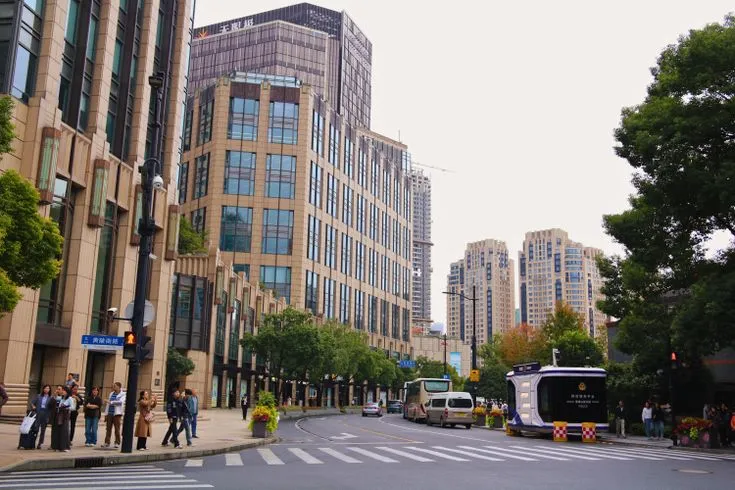
A China Free Trade Zone is a defined geographic area, usually a district or a cluster of districts inside a major city, where the central government pilots policies it isn’t yet ready to roll out across the whole country. The first one launched in Shanghai in September 2013, built around four existing bonded zones in Pudong. The idea was straightforward: instead of changing foreign investment rules for all of China at once, test them in a contained area first, watch what happens, then decide what to keep.
Inside an FTZ, three mechanisms do most of the work. The first is the negative list, a published list of sectors where foreign ownership is restricted or capped. Anything not on the list is open by default, which flips the old approval-based system on its head. The second is streamlined customs, including bonded warehousing and faster clearance for goods moving through the zone. The third is the Free Trade Account, a special banking mechanism that lets registered companies move cross-border RMB and foreign currency without the standard approval cycle that applies to ordinary mainland entities.
What an FTZ is not, despite the name, is a blanket tax break. Some sub-zones carry a reduced corporate income tax for qualifying industries. Most don’t. The “free trade” in the name refers to trade and investment liberalization, not automatic tax exemption, and treating the two as the same thing is one of the more common mistakes foreign investors make when they first start researching China entry.
Free Trade Zone, Free Trade Port, Special Economic Zone, or Free Trade Agreement: What’s the Difference?
China’s naming conventions overlap in ways that trip up almost every first-time investor searching this topic, so it’s worth separating them clearly before going any further.
Free Trade Zone (FTZ) vs. Pilot Free Trade Zone (PFTZ)
In everyday use these are the same thing. The official Chinese term translates as “pilot free trade zone” to emphasize the experimental, testbed nature of the policy, but almost everyone, including Chinese officials in casual speech, shortens it to FTZ.
Free Trade Zone vs. Special Economic Zone (SEZ)
SEZs came first, dating back to Shenzhen, Zhuhai, Shantou, and Xiamen in the early 1980s under Deng Xiaoping’s reform push. They’re broader, older, and city-wide rather than district-specific, and they focus on general foreign investment and export-oriented manufacturing rather than the narrower customs and financial testing that defines an FTZ. Some FTZs sit inside SEZ boundaries, which is part of why the two get confused.
Free Trade Zone vs. Free Trade Port (FTP)
Hainan is the one everyone points to. The Hainan Free Trade Port is not one of the 23 Pilot FTZs. It’s a separate, province-wide regime that closed its island-wide customs perimeter in December 2025, giving it its own zero-tariff catalogue, its own 15% corporate tax rate through 2027, and a 15% personal income tax cap for qualifying talent. Treat any article that lumps Hainan in as “FTZ number 18” or similar with some caution. It runs under its own law.
Free Trade Zone vs. Free Trade Agreement (FTA)
This is the mix-up that sends the most search traffic astray. A Free Trade Agreement, like RCEP or the China-Australia FTA, is a treaty between countries that lowers tariffs and trade barriers between them. A Free Trade Zone is a domestic policy area inside China with no other country as a counterparty. If you were searching for tariff reductions between China and your home country, you were looking for an FTA, not an FTZ, and this article won’t help you with that.
Comprehensive Bonded Zone (CBZ)
A CBZ is a narrower, customs-focused area, usually smaller than an FTZ subzone, built for bonded import, processing, and re-export. Many older bonded zones and export processing zones have been folded into CBZs over the past fifteen years. An FTZ can contain one or more CBZs inside it, which is another source of the terminology tangle.
What Are China’s Key Free Trade Zones in 2026?
China’s Pilot Free Trade Zone network grew in seven batches between 2013 and 2026, moving from the eastern coast inland and finally to the northern border. Not every zone matters equally to every foreign investor, so the zones below are the ones with the most developed foreign-investment infrastructure and the clearest industry brief.
Shanghai (established 2013)
Shanghai’s FTZ is the original, and it remains the deepest in service infrastructure. Its Lingang Special Area is one of only four zones nationwide offering a 15% corporate income tax rate, for companies in integrated circuits, AI, biopharma, and civil aviation that meet the substance and revenue tests. Shanghai suits trading companies, financial services, and regional headquarters operations.
Shenzhen, via the Guangdong FTZ (established 2015)
Shenzhen’s Qianhai subzone is the second of the four 15% CIT zones, aimed at modern logistics, information services, and Hong Kong-linked professional services, with the incentive currently running through the end of 2027. Shenzhen’s proximity to Hong Kong makes it a common choice for hardware, electronics, and cross-border e-commerce businesses.
Guangzhou Nansha, also under the Guangdong FTZ
Nansha is the third 15% CIT zone, valid through the end of 2026 with an extension widely expected, and it carries an unusual perk: a 13-year loss carry-over for qualifying tech and SME enterprises. It suits marine science, intelligent manufacturing, and Greater Bay Area logistics operations.
Hainan Free Trade Port
Covered separately above because it isn’t technically a Pilot FTZ, Hainan is worth a second mention here because it’s the fourth of the four 15% CIT zones and the most aggressive on customs liberalization, with roughly 6,600 zero-tariff import lines after its December 2025 customs closure. It fits tourism, marine economy, and value-added export operations that process goods for tariff-free re-export to the mainland.
Beijing (established 2020)
Beijing’s FTZ is built around its “Two Zones” framework, useful for businesses whose main clients are government ministries or state-owned enterprises, and for companies in telecom, healthcare, or education looking to use recent pilot openings in those sectors.
Beyond these five, the remaining zones (Tianjin, Fujian, Chongqing, Sichuan, Jiangsu, Zhejiang, and others) each carry a distinct regional focus, from aviation finance in Tianjin to semiconductors in Jiangsu’s Suzhou area. The newest, Inner Mongolia, was approved in April 2026 and is built around rare earth supply chains and cross-border logistics with Russia and Mongolia. None of these carry the 15% CIT incentive; their value is mainly in customs facilitation and sector-specific regulatory openings rather than tax.
Notes from InvestinAsia Consultants
The question we get most often isn’t “which FTZ is best,” it’s “do I even need one.” Founders come in having read that Shanghai or Shenzhen offer big tax breaks, then find out during scoping that their business doesn’t qualify for the encouraged-industries catalogue those breaks are tied to. The zone matters far less than whether your actual business activity fits one of the four narrow CIT catalogues. Most service and trading companies don’t, and that’s fine. It just means the decision comes down to city and logistics, not zone-hunting.
What Benefits Do Companies Get Inside a China Free Trade Zone?
The realistic benefits of FTZ registration fall into three categories. Customs facilitation is the most consistent one: faster clearance, bonded warehousing, and simplified declarations for companies that import or re-export physical goods. Financial access is the second: Free Trade Account eligibility, which matters if your business does meaningful cross-border cash pooling or treasury work, and which expanded further under a January 2025 policy package covering cross-border payments and RMB internationalisation. The third, and the one most people ask about first, is tax, but as covered above, this only applies to four specific zones and only to companies whose main business sits inside a defined encouraged-industries catalogue.
What FTZs don’t uniquely provide anymore is manufacturing access. That used to be a real differentiator: FTZs opened manufacturing to full foreign ownership years before the rest of the country. The 2024 national negative list closed that gap by removing the last manufacturing restrictions nationwide, which is the single biggest reason the FTZ decision matters less today than it did five years ago for a manufacturing WFOE.
Also Read: WFOE in China: What It Is, When to Use It, and Key Requirements
Do You Actually Need to Register Inside an FTZ?
For most straightforward service, consulting, or trading companies, no, not as a hard requirement. If your business activity isn’t on the national negative list, which now excludes nearly all manufacturing and most services, you can register a WFOE anywhere in China and access the same core rights: full foreign ownership, the ability to hire directly, issue RMB invoices, and repatriate profits.
Where FTZ registration genuinely earns its complexity is narrower than most guides suggest. It’s worth pursuing if your business does regular cross-border treasury or cash pooling and needs Free Trade Account access, if you import or re-export physical goods at a volume where customs delays cost real money, if your business activity fits inside one of the four 15% CIT catalogues with substance you can actually demonstrate, or if you’re in a sector like basic telecom or financial services where the FTZ negative list is meaningfully more open than the national one.
If none of those apply, chasing an FTZ address mainly adds a step to your entity-formation decision without adding much practical benefit. City choice, based on where your customers, suppliers, or talent actually are, usually matters more than zone status.
How Much Does It Cost to Register a Company in China?
Real numbers matter more here than most guides provide, so here’s what full-service China company registration actually costs through InvestinAsia (part of the vOffice Group), whether or not the entity sits inside an FTZ.
| Package | What’s included | Price |
|---|---|---|
| Essential | Incorporation, government fees and stamp duty, Certificate of Incorporation, Articles of Association, Business Registration Certificate, bank account document preparation, monthly accounting and tax filing | USD 4,909 |
| Complete | Everything in Essential, plus corporate secretary support, filing deadline reminders, and 1 year of registered address in Shenzhen, Xi’an, or Wuhan | USD 6,100 |
Registration through SAMR typically takes 7 to 10 business days once your documents are complete. There’s no strict statutory minimum for registered capital in most sectors, though RMB 100,000 is the widely used starting figure in practice, and under the 2024 Company Law you have up to five years to fully contribute whatever amount you declare. One requirement that catches almost every foreign founder off guard: opening the company bank account requires the owner to be physically present in China. It’s not something a proxy or power of attorney can handle.
Setting up a service or trading company that doesn’t need FTZ-specific customs treatment doesn’t cost meaningfully more or less whether the registered address sits inside a zone or not. The cost difference, when there is one, comes from the registered address package and the complexity of the business scope, not from FTZ status itself. If you want the full breakdown of documents, timelines, and city comparisons, InvestinAsia’s China market entry team can walk through your specific business model and tell you honestly whether an FTZ registration is worth it for your case.
Also Read: How to Register a Company in China as a Foreign Investor: Complete Guide (2026)
What Mistakes Do Foreign Investors Make With China’s Free Trade Zones?
Notes from InvestinAsia Consultants
The most expensive mistake we see is picking a zone for its name recognition, registering in Shanghai or Shenzhen because it sounds like the safe choice, then discovering a smaller inland city would have put the company closer to its actual customers or suppliers for a lower registered address cost. Zone prestige doesn’t show up anywhere on a balance sheet. Fit does.
The second common mistake is assuming “free trade zone” means tax-free. It doesn’t, and applying for the wrong incentive category based on a misread of your own business scope can trigger a rejected application or, worse, a tax bureau review later if you claimed a rate you didn’t qualify for. The third is underestimating the substance test behind the four 15% CIT zones. Qualifying isn’t just about the address; tax authorities check that a meaningful share of your actual revenue comes from the encouraged-industries catalogue, not just that your business license lists the right words.
Still not sure whether an FTZ makes sense for your business?
Our China team will walk through your business model and give you a straight answer, backed by 18+ years of Asia market entry experience.
Frequently Asked Questions
How many free trade zones does China have in 2026?
China has 23 Pilot Free Trade Zones as of April 2026, after Inner Mongolia’s approval brought the network to its current total. The Hainan Free Trade Port is a separate regime and isn’t counted among the 23.
Is a China Free Trade Zone the same as a tax-free zone?
No. Most FTZs offer customs facilitation and financial-account access rather than tax breaks. Only four zones (Shanghai Lingang, Shenzhen Qianhai, Guangzhou Nansha, and the separately governed Hainan Free Trade Port) offer a reduced 15% corporate income tax, and only for companies in specific encouraged industries.
What is the difference between an FTZ and a Special Economic Zone in China?
SEZs are older, broader, city-wide reform zones dating to the early 1980s, focused on general foreign investment and manufacturing. FTZs are newer, narrower, district-level pilot zones focused on testing customs, investment, and financial policy before national rollout. Some FTZs sit inside SEZ boundaries.
Do I need to register my company inside an FTZ to do business in China?
Not for most service, consulting, or trading businesses. Since the 2024 national negative list removed the remaining manufacturing restrictions, a standard WFOE registered anywhere in China gets full foreign ownership, the ability to hire directly, and profit repatriation rights, without needing FTZ status.
How much does it cost to register a company in China?
Full-service registration packages start at USD 4,909, covering incorporation, government fees, and basic accounting and tax filing. Registration through SAMR typically takes 7 to 10 business days once all documents are prepared, regardless of whether the address sits inside an FTZ.
Is Hainan a free trade zone or a free trade port?
Hainan is a Free Trade Port, not one of China’s 23 Pilot Free Trade Zones. It operates under its own legislation, with its own zero-tariff customs catalogue, a 15% corporate tax rate through 2027, and a 15% personal income tax cap for qualifying talent.
References
1. China Briefing. (2026). How China’s Foreign Investment Negative List Works: A Guide for Investors. Retrieved from
https://www.china-briefing.com/news/chinas-foreign-investment-negative-list-guide/
2. Shanghai Municipal People’s Government. (2024). Negative Lists for Foreign Investment Access. Retrieved from
https://english.shanghai.gov.cn/en-EstablishaCompany/20241206/79a661cdd4da41b8b932b821b9ae5318.html
3. Beijing Municipal Bureau of Commerce. (2024). China Lifts Foreign Investment Access Restrictions in Manufacturing Sector. Retrieved from
https://wb.beijing.gov.cn/en/express/202411/t20241111_3938954.html